Queen Elizabeth’s Pancakes (Her 1960 Drop Scones Recipe)
These Queen Elizabeth’s pancakes come straight from the drop scone recipe Queen Elizabeth II mailed to President Eisenhower in 1960. One surprising pantry ingredient, cream of tartar, makes them thick, tall, and fluffy, and a little splash of vanilla and almond makes them taste special. They’re ready in about 30 minutes, and there’s one easy tweak I’d make to take them from great to perfect.
A Breakfast Fit for a Queen
I recently came across Queen Elizabeth’s pancake recipe, and one ingredient stopped me in my tracks: cream of tartar. I’ve used it in cookies and cakes for years, because it helps make them soft and fluffy, but I had never once put it in pancakes. So of course I had to try it.
Here’s what makes this recipe so fun. It comes from a real letter. After President Eisenhower and his wife visited the Queen at Balmoral in 1959, she promised to send him the recipe for the drop scones he’d enjoyed there. A few months later, she saw a newspaper picture of him grilling at a barbecue, remembered her promise, and sent it along in January 1960. That letter is still kept in the U.S. National Archives, and you can see the original recipe here.
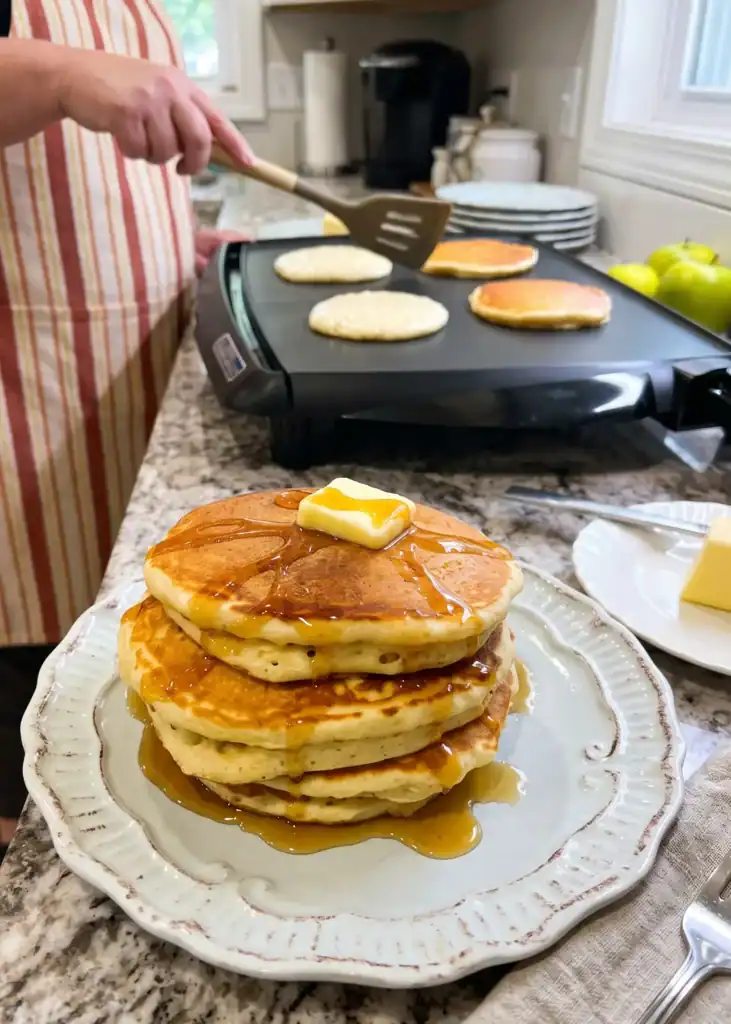
Drop scones are what we’d call a thick pancake here in the States. Some folks call them Scotch pancakes. The Queen’s original measured everything in teacups and was written to serve 16 people. She even mentioned in her letter that when she cooked for fewer folks, she used less flour and milk but kept everything else the same. That’s exactly what I did. I scaled the flour down to 3 cups and the milk to 1 1/2 cups, and I kept the eggs, sugar, butter, baking soda, and cream of tartar just as she wrote them.
I did add my own little touch: half a teaspoon of vanilla and just a quarter teaspoon of almond extract. It’s really just a splash, but it smelled so good the minute it hit the bowl.
Now, I’ll be honest with you. Darren had some fun at my expense while we filmed this one. When I said we might not be royalty, he told me I was his queen, and then informed me he’d just finished cleaning my throne. I try so hard with him, y’all. But I’ll give him this: he really does treat me like a queen.
How Did They Turn Out?
When I let the batter rest, it turned thick and bubbly in a way I’ve never seen pancake batter do before. And when I flipped that first one, it was perfectly golden.
The texture is hard to describe. They’re light and fluffy, but with a little substance to them, almost a slight denseness that I really love. They’re tall, they’re thick, and they’re good. My only change? A pinch of salt next time to balance out the sweetness. Other than that, the Queen knew exactly what she was doing.
What You’ll Need
- All-purpose flour: Spoon it into the cup and level it off so the pancakes stay light.
- Granulated sugar: Just enough to sweeten the batter.
- Baking soda and cream of tartar: Together they work like homemade baking powder and give these their height.
- Eggs, milk, and melted butter: Simple staples that bring it all together.
- Vanilla and almond extract: My additions for a little extra flavor.
- A pinch of salt: Not in the original, but I recommend it.
Tips for the Best Queen Elizabeth’s Pancakes
- Don’t skip the cream of tartar. It reacts with the baking soda to give these their height and that soft, unique texture.
- Add the salt. The original recipe doesn’t call for it, but a pinch balances the sweetness beautifully.
- Lumpy is fine. Overmixing makes pancakes tough. Stir just until the dry pockets are gone.
- Peek before you flip. Thanks to the thick batter, the tops won’t dry out like you’re used to. Check the bottoms for that golden color instead.
- Play with the flavorings. For a full batch like this, you can bump up the vanilla and almond a little, or swap in a different extract altogether.
- Give them space. These are thick, so leave yourself plenty of room on the griddle to get a spatula under them.
Frequently Asked Questions
What is Queen Elizabeth’s pancake recipe?
It’s the drop scone recipe Queen Elizabeth II sent to President Eisenhower in January 1960. It uses flour, sugar, milk, eggs, baking soda, cream of tartar, and melted butter, and it makes thick, fluffy pancakes.
What’s the difference between drop scones and pancakes?
Drop scones, also called Scotch pancakes, are a British style of pancake. They’re smaller and thicker than many American pancakes, and the batter is dropped onto the griddle in rounds.
Why is there cream of tartar in these pancakes?
Cream of tartar is an acid. Paired with baking soda, it works like homemade baking powder, giving the pancakes lift and a soft, tender texture.
Can I use baking powder instead of baking soda and cream of tartar?
You can. A common swap is about 1 teaspoon of baking powder for every 1/4 teaspoon baking soda plus 1/2 teaspoon cream of tartar. The texture may be slightly different from the original, but it’ll still make a good pancake.
Why does the batter need to rest?
A short rest lets the leaveners get to work and the flour hydrate. You’ll see the batter turn thick and bubbly. Just don’t let it sit too long. About 5 minutes is plenty.
How do I know when to flip them?
These won’t look as dry on top as regular pancakes do. Lift the edge of one and check underneath. When it’s golden brown, it’s time to flip.
What temperature should my griddle be?
We cooked ours at 350°F. If your griddle runs hot or the pancakes brown before the middle is done, turn it down a touch.
Can I make the batter ahead of time?
It’s best cooked shortly after mixing, since the cream of tartar and baking soda start reacting right away. To prep ahead, measure the dry ingredients the night before and mix in the wet ingredients in the morning.
Can I freeze these pancakes?
Yes. Let them cool completely, freeze them in a single layer, then store in a freezer bag. Reheat in the toaster or microwave.
Can I make a smaller batch?
Absolutely, and the Queen herself said she did. She used less flour and milk when cooking for fewer people while keeping the other ingredients the same, which is exactly how this version was scaled.
Give These a Try
I’m so glad we tried this recipe. I really think it’s going to be one we come back to, maybe with a little more salt, maybe with a different hint of flavor now and then. Everybody can make pancakes, so I hope you’ll give these a try in your kitchen too.
Looking for more breakfast ideas? Try our Monte Cristo Breakfast Casserole, French Toast Casserole, Make-Ahead Egg Bites, and Buttermilk Biscuits with Fried Apples.
Thank you so much for joining me at Mary Katherine’s Table. And remember to go out today and find somebody who needs a little bit of kindness and give them some of yours.
Queen Elizabeth’s Pancakes
Ingredients
Dry Ingredients
- 3 cups all-purpose flour spooned in and leveled
- 4 tablespoons granulated sugar
- 2 teaspoons baking soda
- 3 teaspoons cream of tartar
- 1 pinch salt optional, recommended
Wet Ingredients
- 2 large eggs
- 1 1/2 cups milk
- 2 tablespoons butter melted
- 1/2 teaspoon vanilla extract
- 1/4 teaspoon almond extract
For Serving
- butter for topping
- maple syrup for topping
Instructions
Make the Batter
- Spoon the flour lightly into your measuring cup and level it off so the pancakes don’t get heavy.
- In a large bowl, whisk together the flour, sugar, baking soda, cream of tartar, and salt (if using) until evenly combined.
- In a separate bowl, beat the eggs lightly. Add the milk, melted butter, vanilla, and almond extract. Measure the almond extract over a separate bowl so you don’t add too much.
- Whisk the wet mixture for 30 to 40 seconds, until it looks a little frothy on top.
- Pour the wet ingredients into the dry and stir with a spoon, scraping the bottom of the bowl, until no dry pockets remain. A few lumps are fine.
- Let the batter rest about 5 minutes while the griddle heats to 350°F. It will turn thick and bubbly.
Cook the Pancakes
- Portion 1/2 cup of batter per pancake onto the griddle, leaving room between each so you can flip them.
- When the bottom is golden brown, flip. The tops won’t look as dry as regular pancakes, so peek underneath to check. Cook until the second side is browned and the center is set.
- Stack and serve warm with butter and maple syrup.
Video
Notes
- The history: Adapted from the drop scone recipe Queen Elizabeth II sent to President Eisenhower in January 1960. The original served 16. This version uses less flour and milk with the other ingredients unchanged, the same way the Queen said she scaled it for smaller groups.
- Add salt: The original recipe has no salt. A pinch balances the sweetness and is the one change I’d make.
- Flavorings: The vanilla and almond are my additions. For this batch size, you can bump them up a little for more flavor.
- Don’t overmix: A slightly lumpy batter makes the most tender pancakes.
- Cook promptly: Cook these soon after the batter rests. Don’t let it sit too long.
- Freezing: Cool completely, freeze in a single layer, then store in a freezer bag. Reheat in the toaster or microwave.